- Niche Media
- Posts
- 👨🏻💻 A Smarter Audience Strategy for 2026
👨🏻💻 A Smarter Audience Strategy for 2026
Most audiences aren’t shrinking. They’re splintering.

Niche Media
February 26, 2026
Brought to you by Modern Litho


Welcome to The Niche Fix. Each week, we will share insights from experts and professionals in the niche publishing industry. Have questions or thoughts about the industry? Reply to this email, and let’s chat!
But first…
We’re giving away a flight to two lucky attendees of the Niche Media Conference!

We are giving away airfare to the Niche Media Conference in Orlando to two lucky winners!
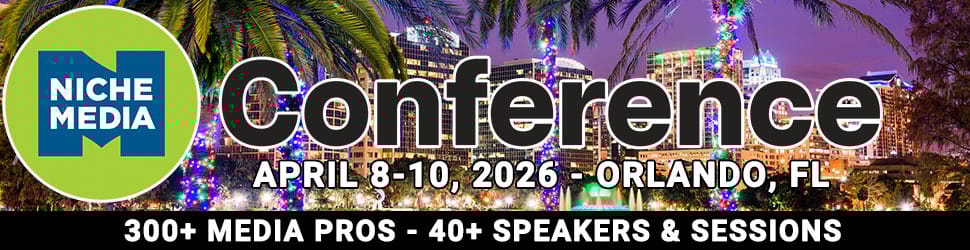
The Niche Media Conference is coming up April 8-10 in Orlando, Florida, and we want to help two attendees with travel to the event. The winners will receive $500 in Southwest or Delta credit to use toward their trip.
Ryan Dohrn’s Sales Corner: The Sales Trifecta

Every salesperson wants the shortcut. Ryan Dohrn’s take? There isn’t one. But there is a pattern.
He calls it the Sales Trifecta — three daily disciplines that separate average sellers from consistent top performers.
1. Build the List
Every sales initiative starts with a focused list inside your CRM. New business. Renewals. An event launch. A special upgrade. Each gets its own project and prospect list.
Ryan typically works with about 50 names per initiative. The number isn’t magic — the focus is. Sales falls apart when it’s random. A clear list tied to a specific revenue goal forces structure and accountability.
2. Work the List With Focus
Next comes execution using the Pomodoro Technique: 25 minutes on. 5 minutes off.
During those 25 minutes, you prospect. Voicemail. Email. No distractions. Then reset your brain for five minutes before the next round.
One focused hour a day compounds quickly.
3. Follow the Pattern
Here’s where discipline wins. Every three business days:
Leave a voicemail referencing the email you’re sending.
Ask them to reply to the email (not call back).
Send a brand-new email with a new subject line.
Repeat this five times. On the sixth touch, offer a polite out if they’re not the right contact.
It’s not annoying. It’s professional persistence.
Ryan isn’t anti-automation, but generic blasts rarely outperform personalized outreach. And while few people answer the phone, voicemail still differentiates you.
There’s no hack here. Just organized focus and polite persistence — repeated until profit follows.
Now, let’s talk audience…
The Great Audience Fragmentation Problem

By Zach O’Brien
For years, “audience growth” was the primary KPI in media. Pageviews were the scoreboard. Unique visitors were the bragging rights. Social followers were the proof that momentum was real.
If the chart moved up and to the right, everyone felt good. If it flattened, panic set in.
But in 2026, something more subtle is happening. Most audiences aren’t shrinking. They’re splintering.
The Myth of One Big Audience
There was a time when a publication could reasonably think of its readership as one centralized group. They came to the website. They read the articles. They maybe subscribed to the print edition. Clean. Linear. Predictable.
That model is gone.
Today, most publishers operate with multiple micro-audiences that barely overlap. You likely have:
Website readers arriving from search or referral traffic
Newsletter subscribers who rarely visit your homepage
Social followers who engage but don’t click
Event attendees who love your brand in person but ignore your emails
Paying members who expect deeper value and access
These groups behave differently. They respond to different incentives. They consume content in different ways. And in many cases, they don’t even know the others exist.
When a publisher says, “Our audience isn’t growing,” what they often mean is that one segment has stalled. Meanwhile, another may be thriving.
The Fragmentation Effect
Fragmentation creates confusion because traditional metrics don’t tell the full story anymore.
You can have flat website traffic and rising email revenue. You can see explosive engagement on LinkedIn while digital ad performance remains steady. You can sell out an event with people who rarely click on your articles.
On paper, that looks inconsistent. In reality, it reflects a more complex ecosystem.
Audiences now orbit brands instead of lining up neatly at the front door. Some prefer curated email experiences. Others want quick insights on social. Some only engage when there’s a live component involved. A portion may never visit your website at all.
Trying to force all of them into the same behavior pattern is inefficient. More importantly, it’s unnecessary.
Why Treating Them as One Is Costing You
When publishers lump all these groups together under the umbrella of “our audience,” messaging becomes generic. Offers become broad. Monetization strategies lose precision.
Your social audience might value speed, personality, and quick takes.
Your newsletter audience likely expects insight and context.
Your event attendees are seeking connection and access.
Your advertisers want outcomes, not impressions.
If you design everything for everyone, you risk resonating deeply with no one.
Recognizing the distinct nature of each micro-audience allows you to tailor value appropriately — and price it accordingly.
From Funnels to Bridges
Most publishers still think in funnels. The goal is to push everyone downward toward a single outcome — typically a subscription or advertiser conversion. But a more effective model today is building bridges.
Instead of asking, “How do we get everyone into the same place?” ask, “How do we create intentional crossover points?”
A practical approach looks like this:
Identify your strongest segment. Which micro-audience is most engaged or most profitable?
Create strategic invitations. Encourage social followers to join your newsletter. Invite newsletter readers to events. Offer event attendees premium membership access.
Accept selective movement. Not everyone will cross every bridge. That’s fine. The goal is depth, not universal conversion.
Some people will remain casual followers indefinitely. They still contribute to brand authority and visibility. But others will gradually deepen their relationship with you — and that’s where real value compounds.
A Better Question for 2026
Instead of asking, “How do we grow our audience?” consider reframing it: “How do we move people between the audiences we already have?”
When someone shifts from social follower to newsletter subscriber, that’s progress. When a subscriber attends an event, that’s momentum. When an event attendee becomes a paying member, that’s durability.
The publishers quietly winning right now are not chasing raw traffic spikes. They’re strengthening connections within their ecosystem. They understand that fragmentation isn’t a failure of growth.
It’s an evolution of attention. Your audience didn’t disappear. It just spread out.
Your opportunity isn’t to chase it harder. It’s to connect it more intentionally.
This issue of the Niche Fix is brought to you by Modern Litho
Modern Litho is a premier print partner for niche publishers, delivering expertly crafted magazines, catalogs, and specialty publications with unmatched quality and reliability. As a multi-award-winning printer, they combine state-of-the-art technology with an attentive, publisher-focused team—ensuring your titles look stunning, reach audiences on time, and reflect your brand’s distinct personality.
Let's Connect!
New to the newsletter? Subscribe for free.